
By Jason Guck, Delta Edge CI
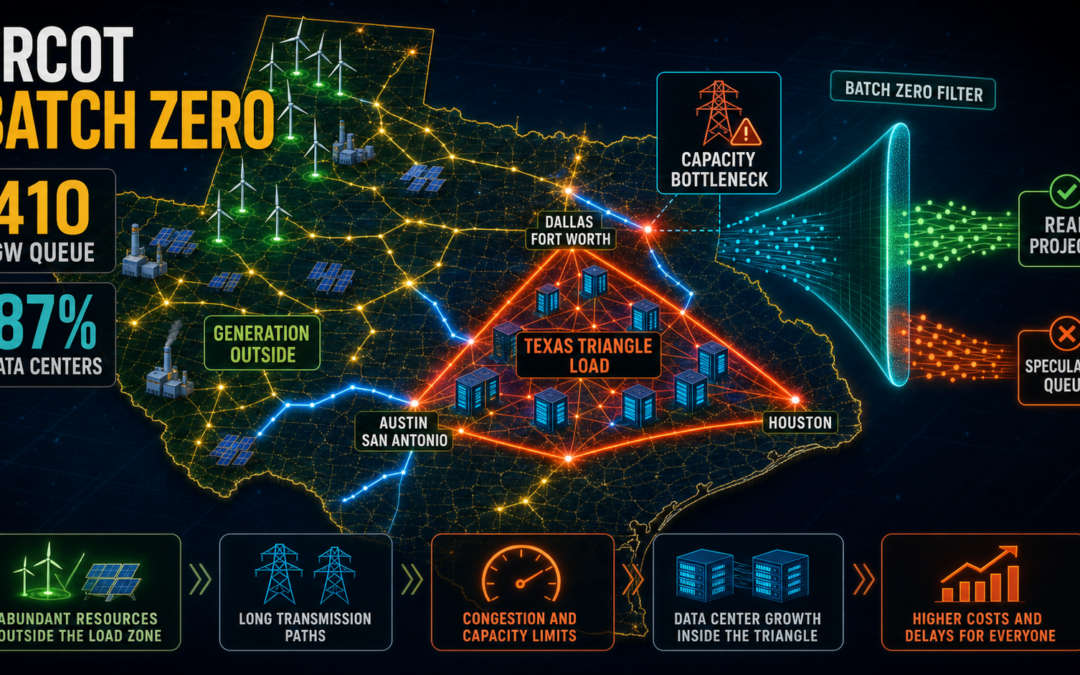
ERCOT’s large-load interconnection queue has crossed 410 gigawatts of requests against a system peak under 90 GW, with 87% of the queue coming from data centers. The grid operator approved energization on roughly 2.2 GW in the last twelve months. The math does not work.
Batch Zero is ERCOT’s first real filter for who in that queue is actually real, ready, and grid-supportive, and who is a placeholder that has been blocking transmission capacity from projects that can actually be built.
The piece nobody is writing yet is what this means for the rest of the Texas C&I customer base: manufacturers, cold storage operators, healthcare systems, multi-site retail, and food processors who never asked to be in the middle of the data-center buildout but are absorbing the cost of it through delivery and transmission charges.
This is the same structural story behind the national commercial utility-cost increase, the broader 2026 energy price curve, and the hidden drivers behind 2026 energy price surges.
Key Takeaways
- ERCOT’s large-load queue: roughly 410 GW of interconnection requests, against a system peak near 90 GW. About 87% are data centers.
- Approved energizations in the last 12 months: roughly 2.2 GW. The queue is not being worked through at anything close to its headline scale. It is growing faster than it can be energized.
- Batch Zero is ERCOT’s transitional study process under PGRR145, filed March 4, 2026, and built to implement Senate Bill 6’s framework for large-load interconnection.
- Two eligibility paths: a Stability Assessment Path and a Valid Study Path. Projects targeting December 31, 2027 energization need to show development progress by July 15, 2026.
- Controllable Load Resource (CLR) and Bring-Your-Own-Generation (BYOG) are the two flexibility mechanisms Batch Zero rewards. Both move risk off the shared grid and back onto the load.
- For existing C&I buyers: the discipline Batch Zero forces on new loads is the same discipline you can apply to your own consumption profile to lower delivery charges that are about to keep climbing.
What Batch Zero Actually Is
Batch Zero is a transitional batch study framework that ERCOT proposed through PGRR145 in March 2026. It is designed to bridge from the legacy first-come-first-served interconnection process to a fully batched process under Senate Bill 6.
The premise is straightforward. ERCOT cannot study a 410 GW queue project by project, and the queue is too speculative to take at face value. Batch Zero is the screen.
To stay in, a project has to demonstrate at least one of two things. Either the load is already in an active stability assessment with valid models and a verified study, or the developer can show site control, executed agreements, financial security, and a defensible energization timeline. Projects that cannot meet one of those bars get pulled out of the queue. The transmission capacity they were holding becomes available to the projects that can actually be built.
The numbers ERCOT shared with Texas lawmakers in April 2026 are sobering. One recent cycle added about 140 GW of new requests. The total queue moved from hundreds of gigawatts to the 410 GW range in a very short window. Against approved energizations under 2.2 GW, the queue is functionally fiction without a filter.
Where the Queue Is Concentrated
Texas data center development is not evenly distributed. Two-thirds of the large-load queue clusters into four metro hubs: Dallas-Fort Worth, Austin, San Antonio, and Houston. The largest planned projects sit in counties around those metros and in parts of the Panhandle and West Texas.
The DFW concentration matters because the I-35 transmission corridor is already congested. When new hyperscale loads stack into a corridor that is at or near transfer limits, the upgrades required to serve them ripple across every customer on that corridor. Existing C&I sites in DFW are not directly in the queue, but they share the wires.
This is the geography problem Batch Zero is built to confront. Batch Zero is the first ERCOT instrument with the discipline to ask whether each new GW of load is being added where it can be served, or whether it is being added on top of a constraint somebody else will be paying to relieve.
Why This Matters for Existing C&I Buyers
The dominant coverage of Batch Zero is written for data-center developers. The audience that should be paying closer attention is the existing C&I buyer base in ERCOT that is going to absorb a portion of the transmission build whether the data centers get built or not.
Three things are worth tracking.
1. The cost-allocation outcome under Senate Bill 6
Batch Zero is the front end of the same regulatory machinery the PUCT is using to decide who pays for the transmission upgrades that serve the new loads. If the cost is recovered from the rate base, every transmission-connected C&I customer pays a share regardless of size.
2. The precedent on Controllable Load and BYOG
ERCOT is signaling, through the eligibility paths in Batch Zero, that loads that can shed under SCED control or that bring their own behind-the-meter generation are preferred. That is a market signal, not just a paperwork requirement.
The same logic applies to existing C&I customers who can demonstrate load flexibility against 4CP intervals or who have on-site generation that reduces grid stress at peak. The value of those capabilities is rising on the new policy floor.
3. The geography of the buildout
If your operations are in DFW, San Antonio, Austin, or Houston, the delivery line on the bill is going to reflect what gets built and what does not on the local transmission system. The Batch Zero filter determines which projects make it through. Watching the Large Load Working Group cadence and the July 15 development-progress milestone is no longer optional for operators in those metros.
What to Do About It in 2026
Three operational levers move the bill against this backdrop. None of them require waiting for the rulemaking to settle.
Build meter-level visibility into 4CP exposure and ancillary uplift
The invoice-level view is too coarse to act on. Most operators do not know which of their sites is setting the 4CP contribution, and the load-shape question Batch Zero is forcing on data centers is the same question every existing C&I site should be asking about its own profile.
Evaluate behind-the-meter generation and load flexibility
The economics of a battery sized to discharge through 4CP intervals, or a CLR-style commitment to curtail under specific conditions, look different in a market that is now explicitly rewarding controllable load. The Delta between your current peak and your achievable peak is the same lever the data-center crowd is being forced to demonstrate at the front end.
Treat the delivery charge as a managed cost
The buyers who absorb the transmission build worst are the ones who never opened the tariff. Conservation Intelligence is the discipline of opening it, finding the leaks, and converting them into measurable Delta savings against the consumption baseline.
Where Delta Edge CI Comes In
DECI is the customer-side Virtual Utility services platform for C&I, municipal, and multi-site operators in ERCOT and the other major deregulated markets. We are not a broker, not an REP, and not a sustainability consultant. We are the accountable operator in a fragmented market.
The Zero Cost Program funds 100% of the engineering, equipment, and installation. The customer puts up zero capital. We guarantee conservation against the utility consumption baseline through a single Managed Services Agreement. On a recent enterprise-wide deployment for a regional health system, the model delivered a 34.4% conservation rate against $143.8 million in baseline utility spend.
The structure transfers cleanly to Texas C&I operators who want their delivery exposure managed against an outcome, not a tariff.
Frequently Asked Questions
What is ERCOT’s Batch Zero?
Batch Zero is a transitional batch study process ERCOT proposed through PGRR145 in March 2026 to filter the existing large-load interconnection queue. It implements the framework in Texas Senate Bill 6 and replaces the legacy first-come-first-served approach with two eligibility paths: a Stability Assessment Path and a Valid Study Path.
How big is ERCOT’s large-load queue?
ERCOT’s large-load queue is in the 410 GW range as of spring 2026, against a system peak near 90 GW. About 87% of the queue is data centers. ERCOT approved energization on roughly 2.2 GW in the last twelve months.
What is PGRR145?
PGRR145 is the Planning Guide Revision Request that codifies Batch Zero. ERCOT filed it on March 4, 2026. It establishes the protocol revisions necessary to move large-load interconnection from a single-project study process to a batched process consistent with Senate Bill 6.
Where are most of the proposed data centers being built in Texas?
The four largest hubs are Dallas-Fort Worth, Austin, San Antonio, and Houston, with significant project concentration around the I-35 corridor, the DFW metro, and selected Panhandle and West Texas counties.
Does Batch Zero apply to existing C&I businesses?
No, not directly. Batch Zero applies to new large-load interconnection requests above the Senate Bill 6 thresholds. Existing C&I customers are affected indirectly through the rate impact of transmission upgrades that serve the new loads, and through the precedent that ERCOT is now explicitly valuing controllable load and behind-the-meter generation.
When are the key Batch Zero deadlines?
The Stability Assessment Path required inclusion in quarterly assessments by May 1, 2026. Projects targeting December 31, 2027 energization need to demonstrate development progress by July 15, 2026. The Large Load Working Group has been meeting monthly to work through implementation details.
What is Controllable Load Resource (CLR)?
A Controllable Load Resource is an ERCOT market participant designation for loads that can be dispatched, curtailed, or scheduled under SCED control. In a Batch Zero context, projects that register as CLRs are preferred because they reduce grid stress at peak instead of adding to it. The same logic applies to existing C&I customers with flexible loads who want to monetize that flexibility through demand-response programs or peak-shaving.
The Bottom Line
ERCOT’s queue is a 410 GW number that hides a much smaller real-world buildable subset. Batch Zero is the first instrument with the discipline to separate the two. For data-center developers, it is a filter to pass. For everyone else in Texas connected to the same grid, it is a leading indicator of where transmission cost recovery is heading and what kind of load behavior is now being rewarded.
The Texas C&I operators who come through the next 24 months in the best shape will be the ones who applied the same discipline Batch Zero is now forcing on data centers to their own load profile. Find the Delta. Close it before the transmission bill catches up.
Related Reading
- What the average U.S. business pays for utilities in 2026 — how the Texas exposure fits into the national commercial rate increase.
- U.S. Energy Prices in 2026: Why Costs Are Rising Fast — broader context for the utility cost curve.
- The Hidden Drivers Behind 2026 Energy Price Surges — the structural pressures behind regional rate movement.
- America’s Power Crisis: 30% Savings via Zero-Cost Conservation — the operating model behind measurable conservation savings.
Sources
- ERCOT. Large Load Update, Senate Committee on Business & Commerce. April 1, 2026.
- ERCOT. Large Load Update, House Committee on State Affairs. April 9, 2026.
- ERCOT. Batch Study Process, Large Load Working Group. January 22, 2026.
- ERCOT Large Load Working Group. May 21, 2026 meeting materials.
- Zero Emission Grid. ERCOT Large Load Interconnection 2026: PGRR145, Batch Zero analysis. 2026.
- EPE Consulting. New Batch Study Framework for Large Load Interconnections. 2026.
- Seyfarth Shaw LLP. ERCOT’s Batch Zero Proposal and What It Means for Large-Load Projects in Texas. 2026.
- Utility Dive. ERCOT’s large load queue jumped almost 300% last year. 2025.
- Latitude Media. ERCOT’s large load queue has nearly quadrupled in a single year. 2026.
- Texas Tribune. ERCOT will soon have new way to consider data centers. January 19, 2026.
Jason Guck is a co-founder and 20+ year operator in telecom and energy services, based in Rochester, NY. Delta Edge CI is the customer-side Virtual Utility services platform for C&I and multi-site operators, helping them close the Delta between current utility spend and optimized performance through the Zero Cost Program and a single Managed Services Agreement.